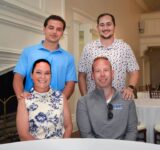
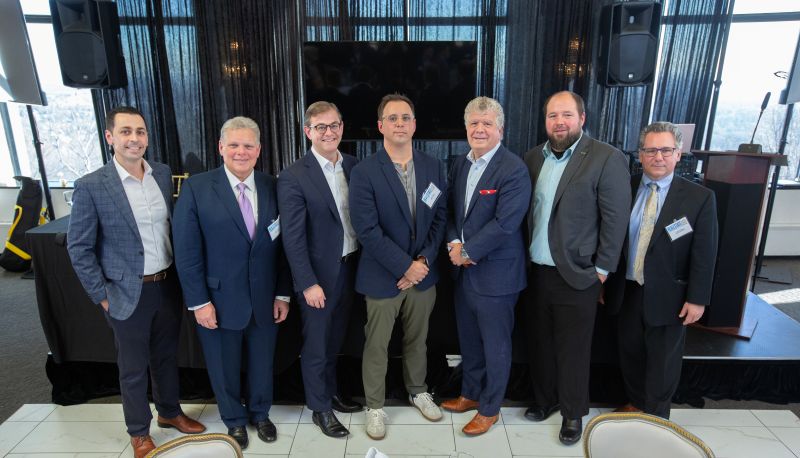
From left: Real Estate NJ’s Josh Burd moderated the Local Land Use panel at the publication’s Dec. 9 event, The State of Redevelopment: Multifamily and Mixed-Use, at The Highlawn in West Orange. Speakers included John Inglesino of Inglesino Taylor LLC, Chris Erb of Russo Development, Jason Chmura of KSS Architects, Stephen Santola of Woodmont Properties, Stephen Hoyt of Pennoni and Joseph DeMarco of Scarinci Hollenbeck LLC. — Photos by Aaron Houston for Real Estate NJ
By Rosa Cirianni
Some veteran real estate experts are predicting “multifamily fatigue” in the Garden State as towns deal with the latest round of state-mandated affordable housing obligations, potentially reshaping the state’s development scene and its pipeline of residential projects.
That was a key takeaway in early December at an event hosted by Real Estate NJ, where a panel discussed how local governments are complying with a law meant to ease the shortage of low- and moderate-income homes. Much of that has centered on redeveloping vacant suburban office parks: As of August 2025, the state had 141 completed or planned office-to-residential or office-to-industrial projects, according to data from Avison Young that was shared during the program, including 109 that have either finished or are under construction and 32 others that are proposed.

“It would have been a slow, painful process but for the affordable housing rounds that we’ve just come through,” said Stephen Santola, executive vice president and general counsel for Woodmont Properties of Fairfield, noting that the mandates and the need for development sites forced many towns to look at their aging office stock. “So the stars kind of aligned in 141 instances — some bigger than others.”
However, he added: “I think once the ‘fourth round’ is over … mayors are going to shut it down for a while. There’s a lot of multifamily fatigue across the state on the political end.”
Santola, a former Livingston mayor, and five other panelists discussed the state Department of Community Affairs’ review that has occurred every decade since New Jersey’s Fair Housing Act of 1985. That followed the state Supreme Court’s landmark Mount Laurel case, which constitutionally requires every New Jersey municipality to deliver affordable housing with the overall aim of eliminating economic and racial segregation through exclusionary zoning.
In 2024, under Gov. Phil Murphy, the state beefed up the law by requiring DCA to calculate new obligations for the so-called fourth round from 2025 to 2035. It also set deadlines for towns to develop and adopt their “fair share” housing plans, seeking to streamline the process and create a new mediation process to negate costly legal battles. As incentives, the law gave bonus credits for plans that adapt former office or retail properties and create special needs housing, among other criteria.

Joseph DeMarco, an attorney and partner at Scarinci Hollenbeck LLC of Little Falls, said local officials have learned that courts are no longer lenient about delaying or sidestepping their obligations.
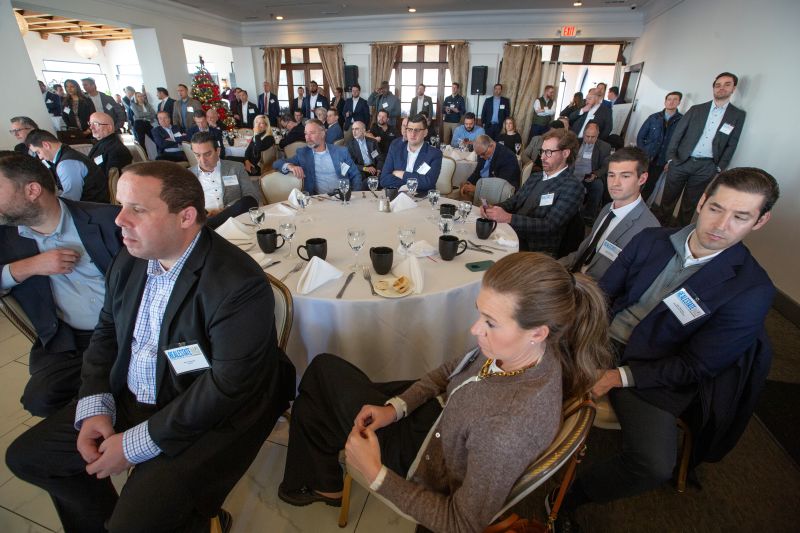
“Towns know they actually have to pick real sites,” that can be developed, said DeMarco, a former municipal business administrator for Bayonne and West New York. He was also one of the six panelists — which included developers, attorneys, design professionals and two former mayors — who spoke before a standing-room-only crowd on Dec. 9 as part of Real Estate NJ’s forum, “The State of Redevelopment: Multifamily and Mixed-Use” at The Highlawn in West Orange.
With the next round slated to begin in 2035, the law required municipalities to adopt their initial fourth-round housing obligations by Jan. 31, 2025, submit full housing plans by June 30 and resolve challenges from developers or other stakeholders by Dec. 31. According to the Fair Share Housing Center, the influential advocacy group, some 380 municipalities had developed compliant plans by year-end, in what it called an unprecedented level of participation and compliance in the state’s affordable housing process.
A modest start, with a ways to go
Still, KSS Architects’ Jason Chmura pointed to the challenges of converting office buildings to residential in New Jersey. Deep floor plates and access and egress points often seem to be some of the biggest hurdles of repurposing office parks that were designed for the 1980s and ’90s, he said. Most of those decades-old campuses also have too much parking and utility density that is no longer needed for today’s more transient workforce, he added, while a central corridor almost always must be added and plumbing tends to be a challenge because kitchens, laundry rooms and bathrooms are part and parcel of residential buildings and not typical of most office buildings.
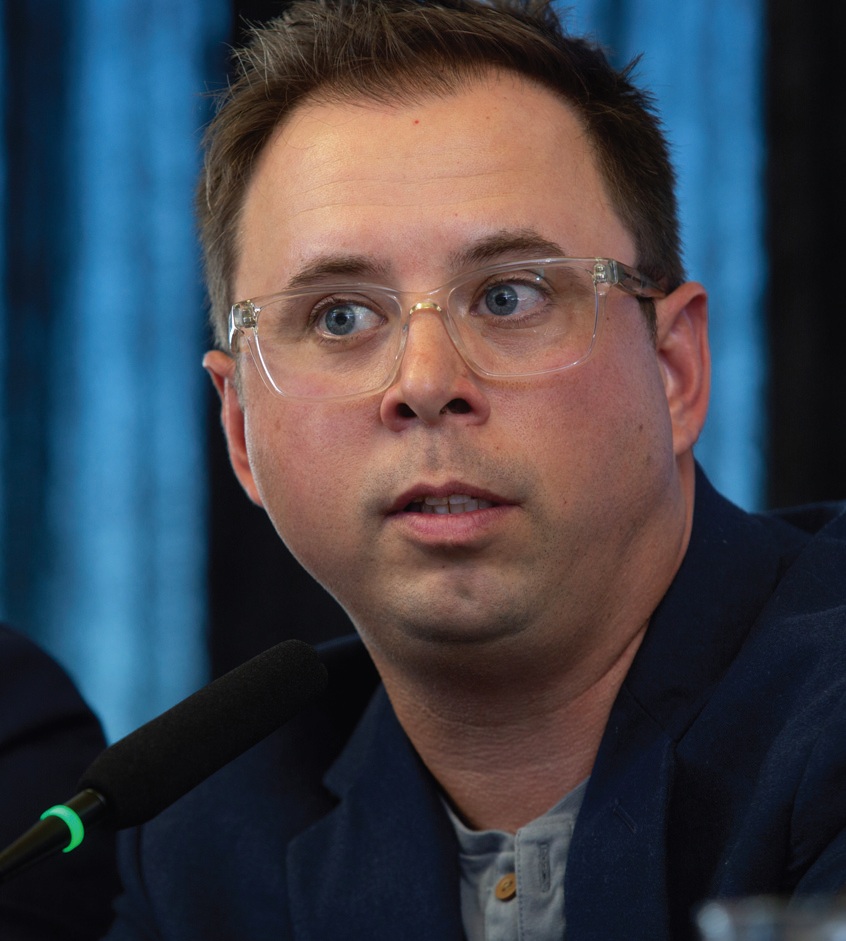
“Once you tally those up, it’s an incredible cost to retrofit a commercial building for that,” said Chmura, a partner with New York-based KSS. “I think we’re going to see different types of uses for the office parks, but we’re also going to see people stretching it and pushing more towards real, more impactful retrofits.”
Chmura also predicted more partial retrofits ahead, such as carving out atriums or removing entire sections while retaining structural shells.
Despite multifamily developments potentially slowing down, panelists said there is still broad opportunity in the suburban office landscape. As noted by Chris Erb, executive vice president of development for Russo Development, conversions could support other asset classes as needs arise.
“I’d say we’re probably a little earlier in the game,” Erb said. “New Jersey has a ton of suburban office … There are going to be plenty of opportunities to retrofit empty office buildings across the state. And if that means that residential isn’t the catalyst for that anymore or is catalyzing it a little bit less moving forward, it means that we’re going to have to find some other uses for some of these vacant office buildings out there.”
Advantages: Decreased traffic, stormwater infrastructure
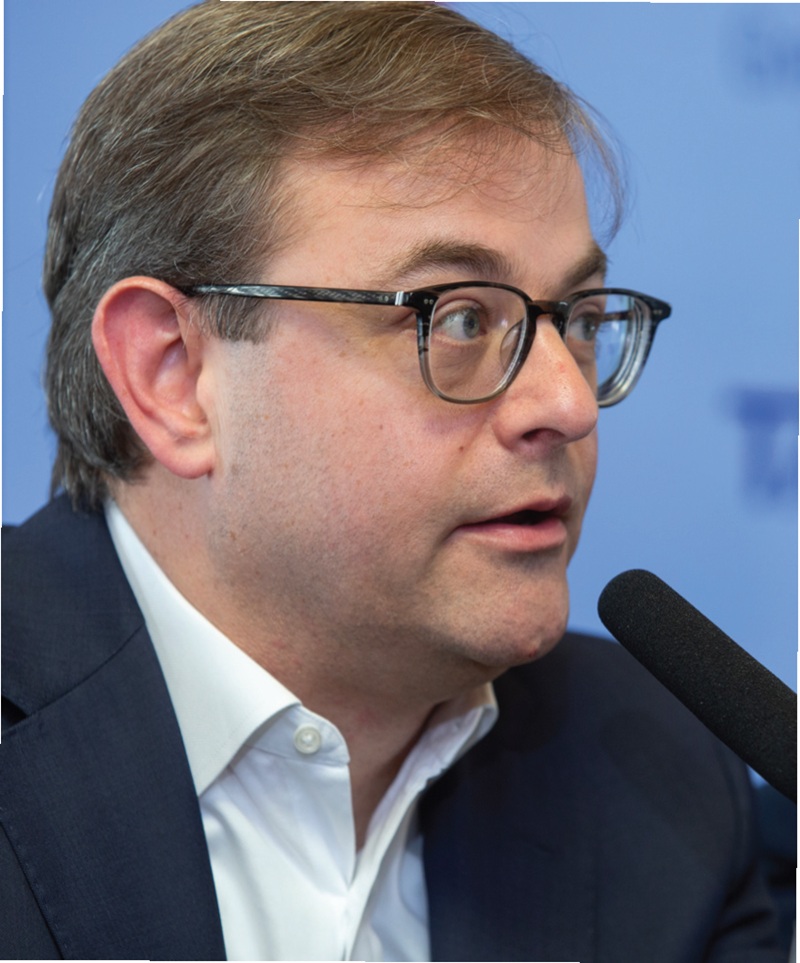
Parking is a big opportunity in suburban office landscapes, where thousands of spots were built and no longer being used or would be needed for residential or mixed-used conversions, according to Erb.
“You’ve got seas of asphalt that can be redeveloped with additional uses,” he added, alluding to parallels between suburban offices and flagging malls.
Mixed-use developments also would improve traffic flow since residential is more diverse with less peak inflow and outflow. That would create a chokehold of some local roads when offices used to operate at peak capacity, according to Erb and Woodmont’s Santola, who said they view that as a selling point to towns considering a redevelopment.
Existing stormwater infrastructure at office parks also makes projects easier to build, even with upgrades and improvements that need to be made, according to Stephen Hoyt, associate vice president and director with Pennoni.

“The fact that the infrastructure is there gets you from point A to point B,” said Hoyt, who leads the firm’s Newark and East Hanover offices. “And it helps on the pro forma side of things to be starting from that template and then building it out.”
From a utility standpoint, he added, “the services are there, so it’s a lot easier to coordinate with these providers and it’s a good infill situation to build around what’s there.”
For-sale townhouses support
John Inglesino, managing and founding partner for the law firm Inglesino Taylor LLC, described how he sees the market preference shifting from large multifamily rental complexes toward for-sale townhouse developments, especially in office parks that are big enough to support them.
“Clearly the trend is to convert vacant office to residential,” Inglesino said.
However, he said municipalities are increasingly resisting dense rental proposals, especially when they have larger office properties.
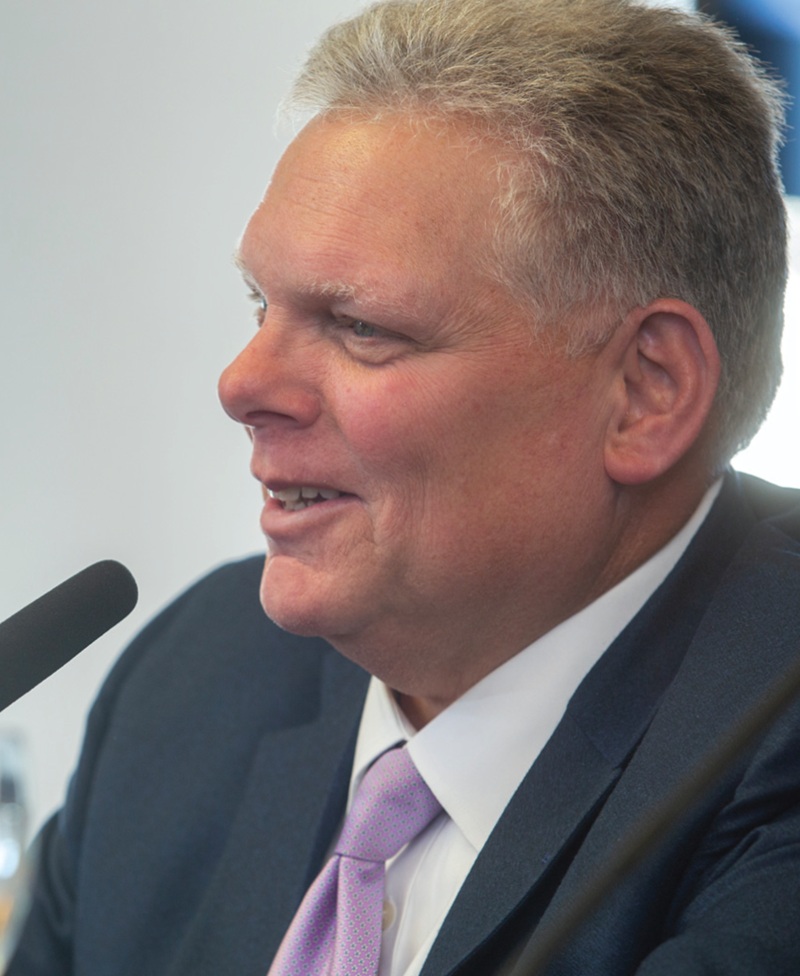
“People don’t like the density, they don’t like the traffic,” said Inglesino, a former Rockaway Township mayor and Morris County Freeholder, adding: “We are seeing political will for upscale for-sale townhouse jobs. That’s where I think the sweet spot is today.”
Panelists also pointed to new incentives built into the revised Fair Housing Act for redeveloping office or retail properties. In those cases, municipalities can count one unit of affordable housing as a unit and a half in their unmet need, though the bonus credit is capped at 25 percent of their obligation.
More compliance and coordination needed
Redevelopment is poised to continue across the state, panelists said, despite potential multifamily fatigue. The state’s housing shortage and the ongoing legal mandates continue to push municipalities and developers toward seeking solutions. And, since there are millions of square feet of unused office space, the experts believe the process is going to continue to evolve.
Following the 2024 law, state officials called for nearly 85,000 more affordable housing units by 2035, with at least half for low-income families, to meet the fourth-round obligations under the Mount Laurel case. The panel experts overall agreed that towns need to meet their mandates.
“We need compliance,” Inglesino said. “And I think that when you look out there along the landscape, I think you’re going to see a lot of settlements out there for towns that are still going to have a big unmet need, and we really, as a community, can’t let that happen. It’s not good for the market. There’s a lot of people out there that need affordable housing, and there’s a lot of other people that need housing.”
Legislative incentives have helped, according to Santola. However, KSS’ Chmura sees many towns in need of full infrastructure upgrades for redevelopment to occur at a faster, smoother pace.
The panelists agreed that more coordination and communication between state and local agencies also would allow the redevelopment process to advance more efficiently and consistently throughout the state.
“(This) is not going to have such a clean beginning and end,” Inglesino said. “This is going to continue in ways that, at the moment, we can’t really envision.”
Alternative uses: Public space and large ground-floor tenants
Not all former offices are only best used as residential buildings.
“It’s whatever uses can work,” Russo Development’s Erb said, adding that uses can be individual to every project and may include life sciences adjacent to retail, office or even hotel space.
In New York, for example, where KSS has several projects, grocery stores are located at the ground level of some residential building developments, Chmura said.
Those types of long-term lease situations with larger tenants and perhaps institutions such as colleges can be good bets for developers.
“Scale of that mixed use is really important,” Chmura said. “Back in the day, the smaller retail establishments at the base of the project worked, but I know from a property management standpoint, that’s a bear. Nobody wants to have to deal with those 1,000-square-foot tenants on a regular basis. So (it’s about) finding something that could be an anchor tenant.”
Incorporating public space into a project also seems to be a winning strategy that the towns are more likely to accept in redevelopment projects, Santola said.
“The other thing I would throw into it is that, with any mixed-use job of any size — public space, public space, public space,” Santola added. “That’s what we’re hearing from all the municipalities. It’s also a great complement to a residential use, if it’s done right and it’s done well.”
Rosa Cirianni is a contributor to Real Estate NJ.
SLIDESHOW: The State of Redevelopment: Multifamily and Mixed-Use