

By Joshua Burd
It’s early, but the New Jersey Builders Association can’t help but be encouraged.
The prominent trade association, which represents residential developers, contractors and other professionals, said a new face in Trenton has brought a new dose of optimism to an industry that’s weary from rising costs and regulatory burdens. That was true even before Gov. Mikie Sherrill took the oath of office in late January, when she homed in on affordability and efficiency in government as part of a well-organized, business-like transition plan that she has carried into the Statehouse.

Jeff Kolakowski
“We’re very optimistic about what we’ve seen from her,” Jeff Kolakowski, the builders association’s CEO, said in an interview in late February. He added: “We feel like policymakers are aware of the challenges that the state faces due to a lack of housing supply. I think they’re getting serious about looking at ways to increase housing production here.”
Chris Amato, NJBA’s board chair, added: “Affordability is top of mind, and it’s both in what we can produce as a state, but also those peripheral costs that are driving up the cost of homes, whether you’re talking about renovation or new homes. The permitting process and the soft costs of construction are major impediments for builders across the state, so any kind of efficiencies we can find in permitting and inspections are a big win … at the end of the day.”
It’s the backdrop for NJBA’s annual Atlantic Builders Convention, which starts March 25 and will once again draw thousands to the Hard Rock Hotel & Casino in Atlantic City for the housing industry’s premier trade show and networking and education event. And it comes amid other potential tailwinds for development, including the ongoing rollout of a law meant to expand affordable housing in the state, but also challenges. Chief among them is a controversial program that significantly increases flood elevations for new construction, which Gov. Phil Murphy’s administration adopted on its last day in office despite sizable opposition.
Aside from challenging the rules in court, NJBA is appealing to the new Sherrill administration for a more measured approach to what it views as a “monumentally restrictive” land use policy.
“This is a pivotal moment,” Kolakowski said. “With a new administration and renewed focus on affordability, we have an opportunity to align policy, permitting and planning in a way that meaningfully increases housing supply across the state.”
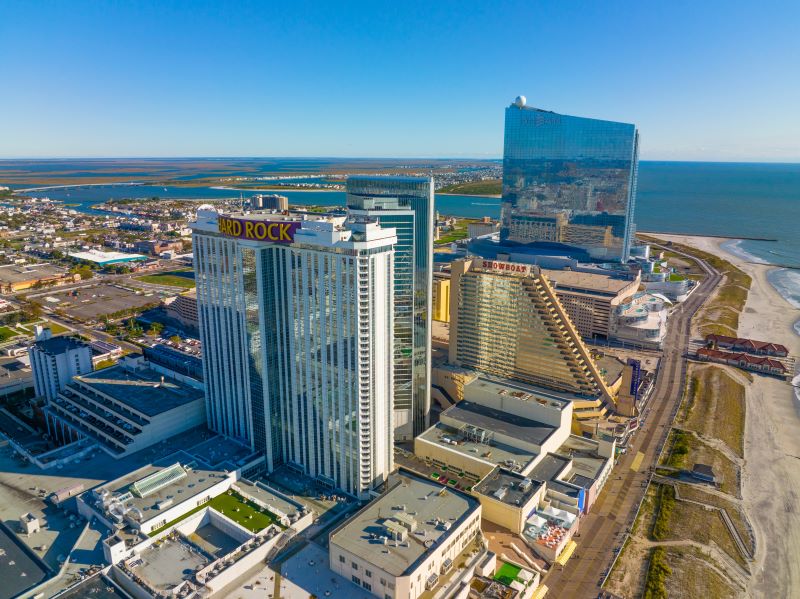
The Atlantic Builders Convention is slated to return to the Hard Rock Hotel & Casino in Atlantic City from March 25 to 26.
Make no mistake: With the convention set to kick off, NJBA is perhaps more bullish than it has been since before the pandemic. It pointed to the creation of the state’s first-ever chief operating officer, a role filled by Kellie Doucette, along with Sherrill’s pledge to develop a real‑time dashboard to track permits and recent executive actions aimed at pausing new regulations and establishing a permitting efficiency task force.
Such steps align closely with builders and developers’ long-held quest for a coordinated, realistic plan for where and how housing can be built in New Jersey.
“It took a long time to dig ourselves into this highly overregulated environment, and it’s going to take a while to unpack it,” Kolakowski said. “So she’s putting a tremendous amount of structure in place.”
That also figures help NJBA’s growing segment of home improvement contractors that, following new legislation, are now required to register with the Division of Consumer Affairs and complete continuing education requirements.

Chris Amato
“Using any kind of new technology to create those efficiencies from the permitting side of things and just noticing all that is a tremendous help to our entire industry and reducing the cost of housing,” said Amato, CEO and president of Wall-based CMM Inc.
In the meantime, homebuilders and their professionals are benefiting from the rollout of A4, the affordable housing law signed by Murphy in March 2024. The measure, which had the backing of NJBA and other major business groups, required the state Department of Community Affairs to calculate new obligations for municipalities and set deadlines for them to reach zoning agreements with developers and advocates, while creating a streamlined mediation process overseen by the state.
“What we advocated strongly for — and I think the policymakers heard us — is that we needed an efficient process so we didn’t spend five years in litigation like we did during the third round,” Kolakowski said, referring to the previous phase under the state’s Fair Housing Act. “And I think, from that perspective, the law is an overwhelming success.”
He added that “it probably exceeded everybody’s expectations” by the fact that more than 400 municipalities are poised to have affordable housing plans in place by the statutory deadline, having opted to participate in the dispute resolution process.
“Is it perfect? No, there are some things that we don’t like as an industry,” Kolakowski said. “But from a process standpoint, it was well structured and it’s going to materialize in units being constructed rather than spending time in court.”

There is more work to do, he conceded, citing estimates that New Jersey still has an unmet need of some 200,000 deed-restricted units for low- and moderate-income residents. Filling that gap will largely hinge on constructing inclusionary projects with market-rate units, he said, meaning the state needs hundreds of thousands of new homes “if we’re going to correct our supply-demand imbalance that is really the primary driver of the high price points that you see here in New Jersey.”
“So we’ve got to figure out a plan, and I think that’s identified in the governor’s transition report to come up in a ‘whole government approach,’ because we need to figure out where those units are going to go, we’re going to need to have infrastructure in place to support those units.”
The road ahead for another key policy issue is not nearly as clear. Not as of early March, when NJBA and the New Jersey Business & Industry Association filed an appeal to block adoption of the so-called Resilient Environments and Landscapes or REAL rules. NJBA has spent years lobbying against the program — which would vastly expand flood-risk areas and raise the required elevations for new development and major renovations in those regions — arguing it would stifle development throughout much of the state, devalue property and compound the affordability crisis.
The regulation is “still our top concern here in the state (and) has been for years,” Kolakowski said. He noted that the Department of Environmental Protection adopted the rules on Murphy’s last day in office, on Jan. 20, providing a six-month grace period that NJBA suggested is all but useless in a state with so many jurisdictions.
“The uncertainty across the board in the industry and in the towns is sending a lot of people in circles,” Amato said. Interpretation of the rule varies from municipality to municipality, he added, while many towns and developers are in a holding pattern.

The statehouse in Trenton
The coalition opposing REAL also includes NAIOP New Jersey, New Jersey Realtors, organized labor and mayors from many coastal towns and other impacted municipalities. Kolakowski also pointed to a new bipartisan resolution sponsored and introduced by state Senate President Nick Scutari, which threatens to invalidate the rule proposal for being inconsistent with legislative intent.
“There has been a large outcry of opposition to this over-the-top rule proposal,” Kolakowski said. NJBA has also urged Sherrill to put a pause on REAL as she did with all other regulations under Executive Order 7, “so that there could be a more detailed analysis about the true impacts of this rule proposal, not only on housing production here in the state, but the state’s overall economic growth.”
Those issues and many others will be front and center when thousands descend on Atlantic City for this year’s ABC, the largest of its kind in the Northeast. And the response to this year’s convention reflects both the strength of the industry and the urgency of the moment, NJBA said, noting that it expects significant growth in attendance and that the expanded exhibit floor sold out in record time, with more than 230 exhibits confirmed.