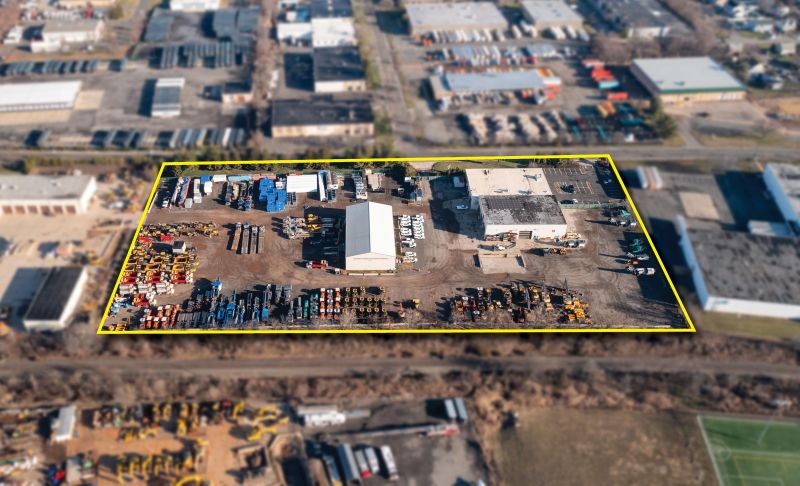
NAI James E. Hanson recently brokered the sale of a 7.81-acre industrial outdoor storage property at 200 St. Nicholas Ave. in South Plainfield. — Courtesy: NAI James E. Hanson
Not all real estate is created equal.
That may be especially true in the industrial outdoor storage sector, which serves everything from trucking firms to equipment rental companies, auto dealers, landscapers and other industries that require small facilities alongside large parking areas.
That makes it all the more difficult for users to find sites in a time of increasing competition. It’s also an opportunity for owners and investors that are able to secure such properties.

“I think the main highlight of the space, as people look at it, is the nuance of these different iOS sites,” NAI James E. Hanson’s Chris Todd said. “A four-acre site with a maintenance building on it and a four-acre site with a terminal on it are two different sites, depending on who you’re talking to, even though they look kind of similar.”
An IOS user with specific needs may have only two or three options to choose from in the market, he said — a far cry from traditional warehouse occupiers — so owners “still have the ability to capture lightning in a bottle based on what specifically your site offers versus what some of these tenants want.”
According to Todd and the firm’s Will Ericksen, the expanding tenant pool has largely coincided with the growth of the IOS market. That became more evident with the onset of a so-called trucking recession, when many small and medium-sized transportation companies folded as the post-pandemic freight boom was ending, even as other types of users were flourishing.

“Out of the trucking recession was this more wide-scale understanding that it was its own asset class,” Ericksen said. “While the trucking recession impacted trucking terminals and traditional warehouse space, specifically, we continued to see rent growth in the IOS space for the other 70 percent of the market that’s taking these low-coverage sites.”
That includes building material suppliers, construction companies and other users that support industries such as real estate and infrastructure.
“You saw the light at the end of the tunnel … (where) there was still a healthy increase in demand from the tenant side,” he said.
NAI Hanson’s Jordan Avanzato also pointed to “the emergence of more high-quality credit occupiers in the market for grade-level, maintenance and service-focused facilities.” What’s more, rising lease rates have caused well-heeled occupiers to consider buying their sites instead.

“The perception that non-logistics-focused IOS occupiers are smaller, non-credit entities is quickly dissipating, as the groups driving the bulk of live requirements in the market are coming from large, well-capitalized, household entities seeking low-coverage maintenance facilities,” Avanzato said. He added: “Large, publicly traded IOS users have been in our market for a while. But the institutionalization of the market, which has rapidly shifted asking-rate dynamics, has forced almost every large, publicly traded IOS occupier to do a full-scale re-evaluation of their current space requirements as well as their buy/lease analyses.”