
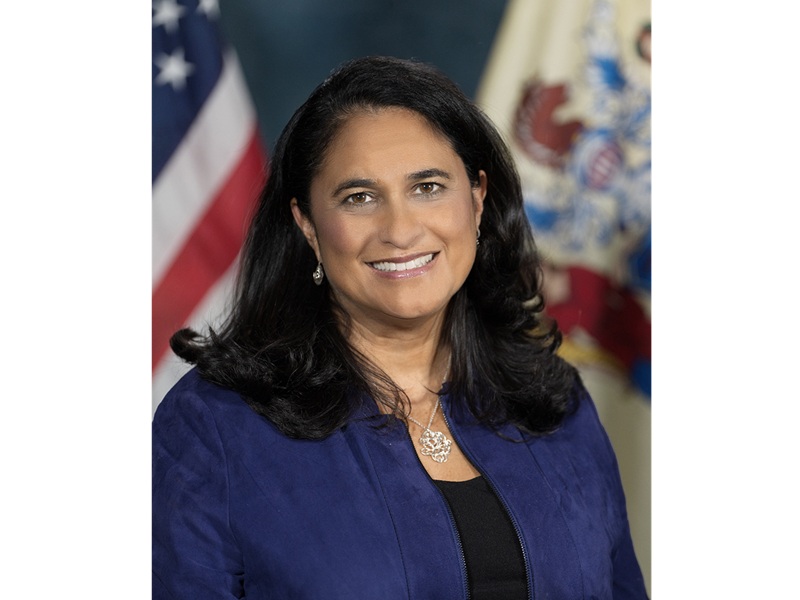
Kellie Doucette
By Joshua Burd
If it wasn’t already clear, Kellie Doucette needed only a quick anecdote to drive home the need for permitting reform in the Garden State.
Just days earlier, she recalled, she was at a meeting “where someone told us about a health care facility that took them nine months to get permitted in New Jersey.”
For a similar project in Pennsylvania, it took 16 days.
“We only have room to go up here,” said Doucette, the state’s first-ever chief operating officer, speaking last week to a crowd of NAIOP New Jersey members. She joked that “maybe my job isn’t as hard as some people may think it is,” referring to a role that’s focused on making state government more efficient to save residents and businesses time and money.
That work is progressing quickly, Doucette said during the association’s annual Public Policy Symposium, in an appearance that came two months into Gov. Mikie Sherrill’s administration. And while “we’re still early in this work,” she said the governor’s office has taken key steps toward streamlining approvals, creating a real-time permitting dashboard and growing headcount at agencies like the Department of Environmental Protection to help ease the backlogs that have vexed developers and other businesses for decades.
Doucette — who leads an office that Sherrill created after being sworn in, following through on a campaign promise — has a central role in many of those initiatives. She pointed to Executive Order 5, which the governor also signed on her first day in office, launching a “cross-agency effort” to eliminate redundancies and establish clearer and more predictable timelines, among other goals.
To that end, the governor’s team continues to meet with business organizations and solicit input on the barriers they face, she said. It’s also pushing ahead with Sherrill’s highly touted plan to reform permitting, directing all agencies to complete a comprehensive catalog of outstanding permits and approvals by the end of April, while requiring them to detail and quantify their processes and provide recommendations for simplifying them.
That effort hinges on the feedback the governor gets from both external stakeholders and the entrenched state workforce, Doucette noted. Sherrill’s team has also consulted with other states where large-scale permitting has taken place “so that we can do this as effectively and efficiently as we can, learn from their mistakes and not be reinventing the wheel.”
“Our hope is that this inventory of permits will surface what’s outdated, what’s duplicative and what adds cost and time without adding value,” she said. “And it really becomes the foundation for the reforms that are required under Executive Order 5.”
Initial working sessions involving the Departments of Transportation, Community Affairs and Environmental Protection have helped identify where interagency coordination breaks down and a path toward developing the permitting “shot clocks” that EO5 requires, Doucette said. The conversations also highlighted additional resource needs, she added, including the notorious staffing shortfalls at DEP that the state now hopes to address with designated funding in Sherrill’s budget proposal.
The governor’s office also continues to develop a real-time permitting dashboard, working in tandem with the New Jersey Innovation Authority, that will ultimately allow applicants to track progress, increase transparency and help identify bottlenecks. It hopes to launch the platform in pilot form by this summer with some 10 projects, a key step toward giving businesses clear visibility into where their application stands and who is responsible for next steps.
“As anxious as we are to get up and running, we also want to make sure we’re doing the upfront work to make sure we’re doing it well,” Doucette said. “So the purpose of that pilot is to pick 10 pretty diverse projects, make sure that the dashboard works for those projects and really follow it through so that, as we’re building things out, we make sure we’re learning along the way.”
It’s all part of an ongoing push to “(make) New Jersey’s broader regulatory environment more workable for businesses operating here.” That also includes reviewing all pending and existing agency regulations, eliminating hiring delays and other aspects of “the operational side of how agencies interact with the businesses that they regulate.”
“What we hear consistently from New Jersey employers, and I know this is especially true for all of you, is that the issue is not always any one single regulation in isolation,” she said. “It’s the unpredictability, it’s rules applied inconsistently, timelines that aren’t clear, processes where a straight answer takes longer than it should. And that uncertainty carries real costs — showing up in legal and compliance expenses, delayed investment decisions and projects that get built in other states.
“The goal is to establish ongoing regulatory review as a standing discipline inside agencies so that evaluating the real-world impact of regulation on business is not a periodic cleanup like we’re trying to do now, but a permanent part of how government operates.”