
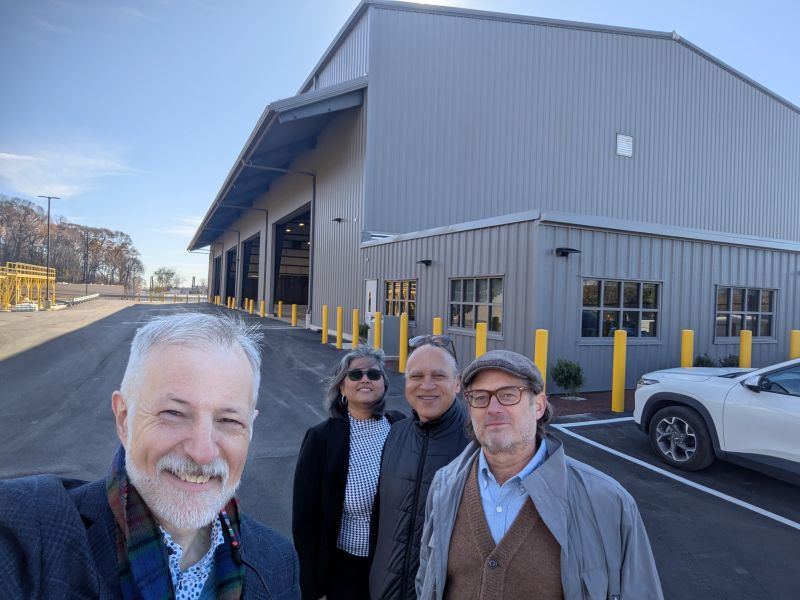
From left: Pictured at the City of Philadelphia Northwest Transfer Station are members of the DIGroup Architecture team: Paul Graebener, senior project manager; Swarupa Samant, principal; Vince Myers, president and cofounding principal; and Scott Hoffman, principal. — Courtesy: DIG
By Joshua Burd
DIGroup Architecture is marking the completion of a new $33 million transfer station in Northwest Philadelphia, having served as a key member of the project’s design team.
The firm, which is based in New Brunswick, said the 21,500-square-foot facility at Domino Lane and Umbria Street replaces a 55-year-old operation and represents a significant improvement in the city’s sanitation and recycling services. That includes enhanced collection efficiency, reduced vehicle downtime and a decreased environmental footprint, including lower vehicle emissions and fuel use, part of a project that also incorporates tarping stations, vehicular scales and rainwater gardens for the site’s stormwater management plan.
DIG provided designs in consultation with Civil and Environmental Consultants Inc.
“The opportunity to design a facility that has such a direct and positive impact on urban infrastructure and community quality of life is central to our firm’s mission,” said Vince Myers, DIG president and a cofounding principal. “This project was about more than just a new building; it was about designing a robust, resilient and technologically advanced system that directly supports the dedicated Sanitation Department team members, enabling them to provide cleaner, more reliable service to the neighborhoods they serve.”
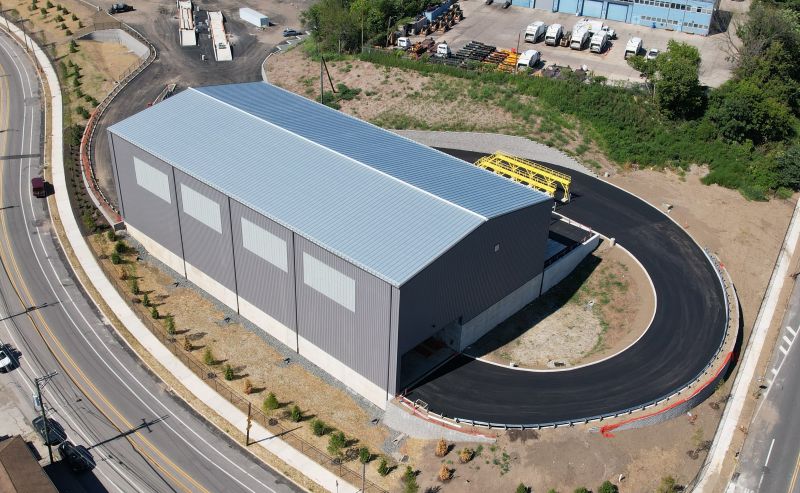
Philadelphia’s new 21,500-square-foot Northwest Transfer Station is now open at 301 West Domino Lane in the city’s Roxborough section. — Courtesy: DIGroup Architecture
Central to the operational efficiency of the Northwest section of Philadelphia, the new transfer station is designed to handle a significant capacity of 550 tons of trash and 100 tons of recyclable material per day, according to a news release. That makes it integral to transforming waste management processes in the area, DIG said, adding that it was tasked with designing the office space as well as assembling all disciplines related to the project, including specialty consultants.
Notably, that meant accounting for a host of physical, regulatory and operational factors and addressing several key architectural challenges to ensure the station is effective, efficient and safe for decades to come, the firm said. DIG’s Paul Graebener, senior project manager, spearheaded that process through construction.
Areas of focus included:
- Capacity and volume management: The physical layout was meticulously designed to handle the combined volume of 650 tons per day while ensuring a smooth, continuous flow of vehicles and materials through the facility.
- Safety and durability: The team designed for an intense industrial environment by using highly durable materials for critical components such as the tipping floor design and push wall height to withstand constant heavy vehicle traffic and abrasive materials, minimizing structural wear and ensuring worker safety.
- Material separation: A key design challenge was integrating the separation of material streams, DIG said, noting that the facility’s layout allows for the efficient and dedicated transfer of recyclable materials alongside solid waste, eliminating long-distance travel between sites and significantly improving collection efficiency.
- Operational flexibility: The architecture ensures the facility is adaptable to evolving fleet needs, accommodating both current vehicle types and potential future equipment or operational process changes. This flexibility is supported by the new Top-Loading Waste Operations system, which DIG said is the current industry standard.
“These architectural solutions also required seamless integration with technology and environmental planning,” said Swarupa Samant, a DIG principal. “In this type of environment, considerations related to advanced fire suppression, automated data management and environmental compliance — to name a few areas — are critically imperative.”
DIG established an office in Philadelphia in 2019, 13 years after its founding, to strengthen its client relationships and presence as it supports a fast-growing portfolio within the region.
DIGroup spearheading rehab of historic public libraries in Philadelphia