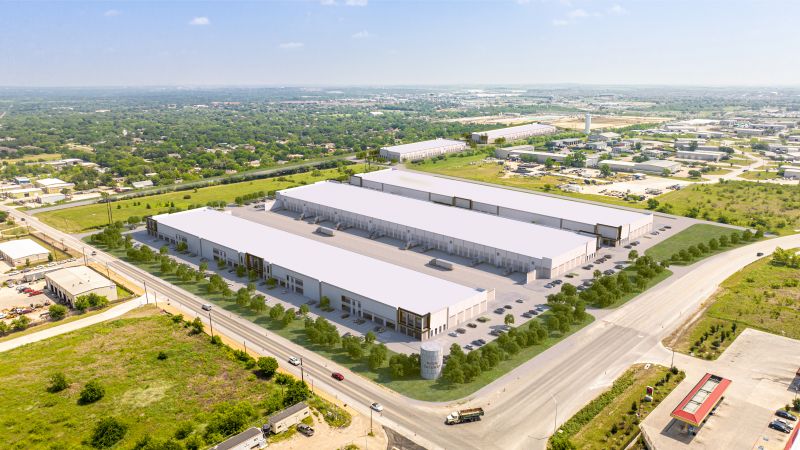
Buda Gateway will comprise five modern light industrial buildings totaling 480,000 square feet in Buda, Texas. — Rendering courtesy: Saxum Real Estate
By Joshua Burd
Saxum Real Estate is expanding its footprint in Texas under a newly announced project that calls for 480,000 square feet of light industrial space across five buildings.
The firm, which is based in Summit, said it was working alongside ArenaMan Development, Drake Real Estate Partners and the Buda Economic Development Corp. in the city of Buda south of Austin. It recently closed on the site after assembling multiple previously underutilized properties, with plans to capitalize the project through an institutional joint venture with Drake and a construction loan from First United Bank.
Known as Buda Gateway, the development represents one of the largest private investments in the city and a major step forward in advancing its long-range economic development strategy, Saxum said, expanding the supply of Class A light industrial space. That bolsters its ability to attract companies in advanced manufacturing, technology and professional services.
“Buda Gateway is a great example of what’s possible through true collaboration,” said Ian Kukowski, vice president of industrial acquisitions at Saxum. “We are grateful to participate in the development efforts and commend ArenaMan Development, the City of Buda and the Buda EDC for tremendous effort and initial vision for what stands to become a critical hub for commerce in Central Texas.”
Two of the planned five buildings are specifically designed to accommodate Buda’s target industry users from sectors such as advanced manufacturing, semiconductors, clean energy, aerospace and defense and knowledge-intensive business services, according to a news release. A key component of the project includes a new roadway connection linking Buda Commerce Center to South Loop 4 — improving mobility, emergency access and long-term transportation capacity within the industrial district — an infrastructure enhancement that will both serve existing employers and accommodate future growth.
Saxum added that the project is expected to support more than 300 new jobs over seven years, including skilled assembly, engineering and professional roles.