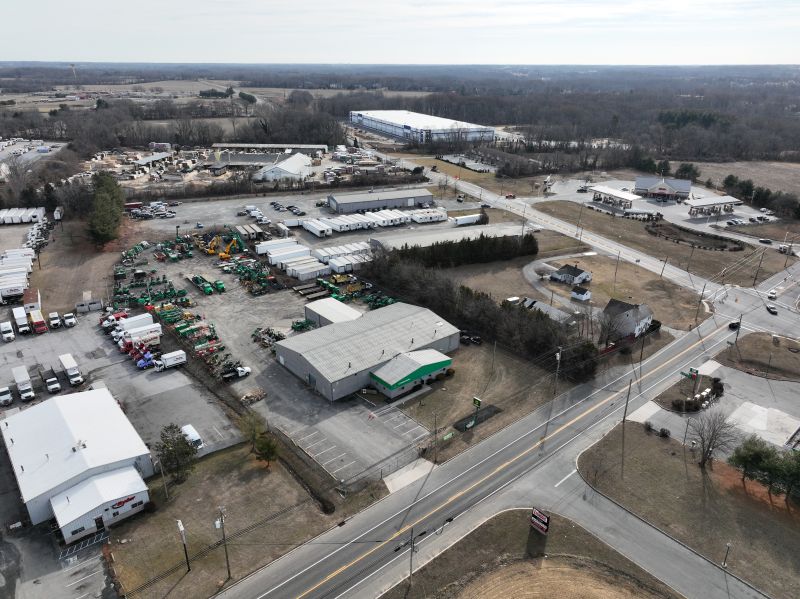
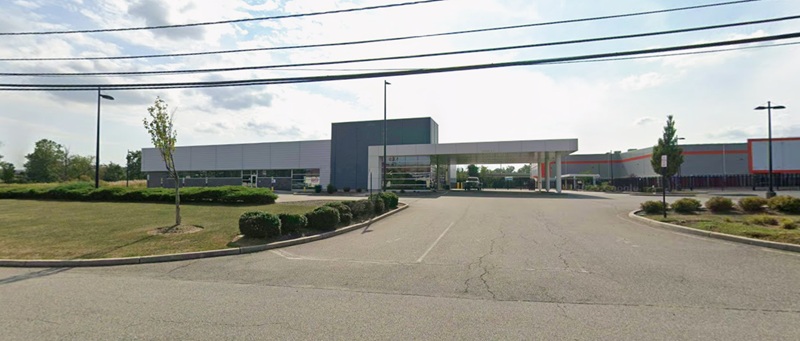
Alterra IOS’ growing portfolio in New Jersey includes a 4.9-acre industrial outdoor storage parcel at 223 Paulsboro Road in Swedesboro. — Courtesy: Alterra IOS
By Joshua Burd
It’s the type of interaction that Blake Chroman is happy to leave in the past.
Five to 10 years ago, he said, trying to get a loan for a low-coverage industrial site would mean meeting with an appraiser who “just wasn’t armed with the data to support these types of valuations.” After all, the asset class was hyperlocal, unremarkable and not widely understood.
The visit could take an awkward turn.

“You’d have a nice meeting and walk the site, and they’d say, ‘OK, so you’ve got this 5,000-square-foot building, but you’re on 10 acres — what should the building rent for per square foot?’” said Chroman, a principal with Englewood-based Sitex Group. “And you’d try to say, ‘Yeah, that’s not really the concept here. You’ve got 10 usable acres.’
“So it was a little bit of a sparring match early on.
“Fast-forward to today,” he added. “The lender sends the appraiser out there. The appraiser seems to have the comps now to support the valuation. So, for me, that little nuance speaks volumes about how the industry has changed.”
The availability of data, he admits, is still a far cry from that of traditional warehouse space. Yet there’s no denying the fast-growing awareness and appeal of what’s now widely known as industrial outdoor storage, or IOS, a once-niche asset class that has become coveted by institutional investors and larger-scale users.
Local, established buyers in New Jersey have responded with a mix of creativity and a willingness to explore lesser-known submarkets, as they navigate higher pricing, increasingly intense competition and zoning constraints for IOS sites.
“You’re finding really well-educated operators in the space,” said Jordan Avanzato, a broker and senior managing director with NAI James E. Hanson, referring to the large funds, real estate investment trusts and other institutions that are now buying sites or partnering with owners of large portfolios. In an interview earlier this year, he noted that “everyone is creating a new bucket for IOS because they have to, because that’s where the leasing velocity is.”
Long dominated by local owners and businesses tied to trucking and logistics, the low-coverage or IOS market has expanded to serve the needs of contractors, building material suppliers, utilities and other industries with large fleets and storage needs. A widely cited report by Newmark found that IOS rents nationally increased 123 percent between 2020 and September 2025, more than twice the rate of bulk warehouses, with roughly half the vacancy rate.
And while there was no such disparity in northern New Jersey — where five-year rent growth for both IOS and bulk warehouse was around 110 percent — low-coverage sites have still drawn an expanding and increasingly sophisticated buyer pool. According to Avanzato and his team, that pool has gone from value-add investors seeking vacant sites or those with shorter lease term to so-called core and core-plus buyers seeking lower-risk opportunities with more stable tenancies.
“You had a certain number of players that had already been in the space or were dipping their toe in from (about) 2020 onward,” said Chris Todd, also a senior managing director with NAI Hanson and member of its NAI Capital Markets & Leasing Team. By around 2023, he said, as leasing and rent growth for the warehouse market were slowing, pricing in the IOS segment found a “new normal” that allowed investors to achieve strong returns.
Institutions have stayed active in New Jersey. Sagard Real Estate, with $6 billion in assets under management, recently teamed with La Caisse to buy a two-property, 1.44-acre portfolio in Moonachie from Sitex Group for roughly $10 million, representing a staggering per-acre price of nearly $7 million. That marked the partnership’s first acquisition under a $360 million fund focused on the industrial outdoor storage segment.
Philadelphia-based Alterra, meantime, has added sites in Morris and Gloucester counties in recent years as part of a footprint that spans nearly 500 locations nationwide. There’s also Jadian, whose IOS affiliate has secured hundreds of millions of dollars in financing from Blackstone for its fast-growing portfolio and has inked a flurry of recent deals in Somerset, Clifton and Avenel.
“It just shows that the appetite from a capital perspective is sort of unending,” said Zach McHugh, a principal with Sitex. He and Chroman spoke earlier this year in an interview that was not related to the firm’s deal with Sagard and La Caisse, which was announced roughly a month later by brokers with JLL.
Sitex, a longtime investor in all types of industrial assets, has stayed competitive by leveraging its creative, entrepreneurial platform. The firm recently acquired the site of a former Progressive claims center in South Plainfield, a 4.1-acre property with a 22,000-square-foot building that it’s now repurposing to attract companies with vehicle fleets or a need for outside storage.
The speculative project, located just off Interstate 287, echoes a plan that Sitex completed in Rutherford after buying a similar facility from the insurance giant in 2023.
“They were effectively the same building, the same kind of a property — Progressive just didn’t need them anymore (because) their business model has shifted,” Chroman said. “So we’re looking at South Plainfield in a very similar light as we did with Rutherford.”
Such a project is only feasible because of a use variance that Sitex obtained from the municipality, he said, allowing it to position the site for a “user audience” that the firm knows is in the market. In places like South Plainfield and Rutherford, that means securing permission for uses such as vehicle repairs, maintenance and collision repair to help a site appeal to companies with large fleets. That’s not to mention outside storage, allowing ownership to monetize the usable acreage around the building.
Sites that are closer to Port Newark-Elizabeth also need to be permitted for container stacking and storage, Chroman added, noting that “the zoning is maybe the biggest component of investing in low-coverage or IOS properties. What you’re looking for, at least what we’re looking for, is the broadest list of permitted uses.”
“We learned that a long time ago when we started investing in these types of properties,” he said. “It’s a key part of our diligence when we investigate the properties, and I think it’s wise to perhaps not close on the acquisition of these properties until and unless you get what you need or at least comfortable with what you have there from a zoning standpoint.”
Avanzato said buyers and users continue “to search for the next IOS market where demand has not yet fully driven up land pricing.” That has raised the profile of submarkets around Interstate 80 and areas such as South Amboy, Sayreville and Old Bridge in Middlesex County, where tenants of late have been “very willing to go … as long as there is a discount in rent.” Those locales are, in turn, drawing the attention of investors that may be getting priced out of top-tier submarkets such as the port region, the Meadowlands and South Plainfield.

Kadima Industrial Partners, formerly known as DH Property Holdings, has bolstered its portfolio by “expanding the market,” the firm’s Eitan Gerszberg said. The company last year acquired two sites in Swedesboro that allowed it to tap into demand for IOS, including a 14.71-acre property at 509 Heron Drive that includes three acres of excess parking alongside a 55,000-square-foot building. It subsequently purchased 22 and 84 Flood Gate Road, which has 28.4 improved acres for outdoor storage alongside its 126,500 square feet of warehouse space.
“The competition right now is really focused between Exit 8 and Exit 12,” said Gerszberg, who joined Kadima in early 2026 as its director of IOS acquisitions. “While we’re still optimistic about the port-centric IOS, despite the volatility over the last couple of years … Southern Jersey presents a lot of interesting opportunities, and those are areas that are a little bit less competitive.”
In a more recent deal, Deugen Investment Group flipped a 16.1-acre property in Cranbury after securing municipal approvals to confirm and expand the site’s permitted IOS use, removing what it described as a key layer of execution risk for prospective users. The firm noted that its primary business plan contemplated a lease but also anticipated the ripple effects of rising rents in northern New Jersey, creating a flight to value that pushed users to markets like Exit 8A along the New Jersey Turnpike.
The eventual buyer, Stonebridge Steel, wound up with a fully entitled, operationally ready asset with infrastructure already in place — including a 35-ton gantry crane extending the length of the property.
“This outcome reflects the flexibility built into our underwriting and the depth of demand we continue to see for well-located industrial assets along the Turnpike corridor,” said Eric Gormeley, CEO of Deugen Investment Group. “The gantry crane represented a sizable cost advantage for the right user, and we’re proud to have matched the asset to an operator who will put it to work.”