
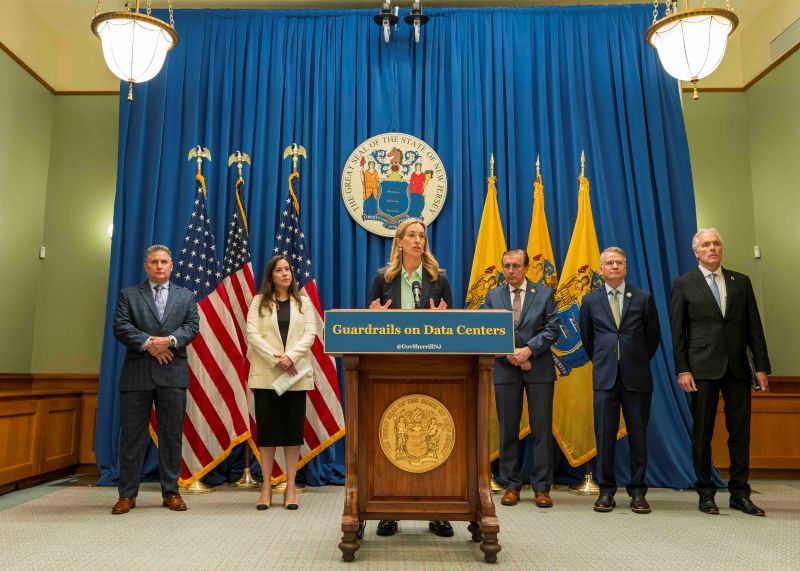
Gov. Mikie Sherrill spoke Wednesday, May 27, to announce a plan to manage the impact of new data center development in New Jersey. Joining her, from left: IBEW Local 102 Business Manager Dave Fiore, Sierra Club New Jersey State Director Anjuli Ramos-Busot, state Sen. John Burzichelli, Assemblyman David Bailey and Mount Arlington Mayor Michael Stanzilis. — Photo by Tim Larsen / Courtesy: Governor’s Office
By Joshua Burd
Gov. Mikie Sherrill is taking steps to manage the impact of new data center development in New Jersey, announcing a plan to establish guardrails while still allowing the state to benefit from innovations in artificial intelligence.
According to Sherrill’s office, the strategy centers on energy demand, resource use and local communities as the market for the facilities continues to grow. It also comes amid the governor’s ongoing focus on affordability and rising utility bills — themes that loom large across the plan’s four key pillars:
- Establishing fair-share rules to ensure data centers bring new clean energy online and contribute to the grid infrastructure needed to support their growth, shifting costs away from residents and ratepayers rather than to them
- Improving transparency starting with requiring reporting on energy and water use so the public has greater visibility into the impact of large-scale facilities
- Developing strong statewide standards for community benefits agreements and providing state resources to ensure municipalities can negotiate from positions of strength, ensuring data centers address impacts like light, noise and pollution while making meaningful local investments
- Delivering good-paying jobs by ensuring the centers leverage local trades and pay prevailing wages
“Data centers are among the biggest drivers of energy costs, which I am working tirelessly to bring down,” Sherrill said in prepared remarks Wednesday. “While many states are approaching this issue piecemeal, this is the first comprehensive plan to tackle it holistically. At the same time, New Jersey will take a thoughtful approach to harnessing investment, lowering costs for ratepayers and leading on AI innovation.
“By establishing these guardrails, we will hold data centers accountable, ensure they contribute their fair share and make sure our communities not only benefit from the AI innovation happening in our state, but have a real hand in shaping it.”
While the announcement did not include additional specifics, business leaders praised Sherrill’s efforts to get out in front of the issue.
“New Jersey is right to focus on data center development in a thoughtful, responsible way,” said Dan Kennedy, CEO of NAIOP New Jersey, the commercial real estate development association. “As the details are worked through, it will be important to balance growth, infrastructure needs, community impacts and long-term competitiveness so we can attract investment while protecting ratepayers and local communities. Governor Sherrill is on the right track.”
Industry experts have long noted that, while New Jersey is an attractive location for data centers, new development is constrained by the state’s lack of electrical capacity and a dearth of available land. Yet there is still growing pushback from residents who live in or near the handful of towns that have large-scale facilities under construction, given the potential strain on the grid and other vital resources.
Other communities are taking steps to proactively ban or limit data center development, as noted by NJ.com and other outlets, while some advocacy groups have called on Sherrill to declare a moratorium on new projects. According to NJ.com, however, the governor on Wednesday rejected such an idea, suggesting that the state can balance economic development with the concerns raised by critics.
Energy costs have been a core issue for Sherrill since the earliest days of her campaign for governor. That continued when she was sworn in on Jan. 20, when she signed executive orders to freeze rate hikes and aggressively expand power generation to bring more affordable energy online for New Jersey families.
Since then, Sherrill and her team have approved six large-scale solar and battery storage projects, announced a historic expansion of community solar to 3,000 megawatts and signed legislation to accelerate battery storage deployment. The governor has also lifted the 50-year moratorium on new nuclear energy.
A new wave of data center demand is coming to New Jersey, but supply may be tighter than ever